


Securing funding or closing an acquisition is never the finish line. It starts a key execution phase.
In practice, many companies face major challenges in the months after a deal: missed deadlines, overworked engineering teams and higher staff turnover. Keeping momentum takes flexibility and resilience.
In an opinion piece published by Maddyness, Xavier Lernould, CEO of Novity, explores practical ways to structure software delivery and keep service continuity during these key growth stages.
The illusion of closing: The reality of the tech market in 2026
Venture capital investors are raising their expectations
The days when companies could secure funding based only on promising ideas or test prototypes are over.
Today, investors and acquirers increasingly value measurable performance, established products and clearly defined markets.
Strong software architecture has become a key factor.
Investors provide financial backing and open doors to strategic opportunities.
However, the job of building, delivering and maintaining a lasting product still sits with the engineering teams.
For tech leaders, this means showing that their company can turn funding into reliable, scalable software.
The Risks of Rapid Permanent Recruitment
When leaders face board commitments, the first response is often to grow the internal engineering team.
However, rapidly raising fixed payroll costs can put pressure on a company's cash runway.
There are other options.
A flexible staffing model, backed by technology and product engineering partners, lets companies adjust capacity as each growth phase changes.
Whether the need is a platform migration, a major product release, international expansion or new regulatory requirements, engineering resources can be adjusted without permanently raising the company's fixed cost base.
Delivery gaps and team fatigue: Common post-funding challenges
After ten years as CTO of software companies and more than seven years supporting French technology businesses, Xavier Lernould has repeatedly seen a growing gap between product ambitions, actual engineering capacity and team wellbeing.
Xavier Lernould's perspective from the field:
« Six, twelve or eighteen months after closing, teams risk becoming overstretched. Expecting the original team to absorb accelerated product development on its own leads to delays and painful scaling challenges. Losing the engagement of key talent comes at the highest cost to your organisation's product knowledge.»
The goal is not just to ship more features. It is to keep quality high, protect know-how and help teams sustain the pace of work.
Planning Engineering Capacity Around Strategic Hiring Windows
To avoid these bottlenecks, CTOs can use key periods through the year to plan resource needs and bring in the right skills.
- January — The start of the year: A chance to launch priority work and build the engineering capacity needed for the first quarter.
- June to August — The summer period: A chance to cut backlog pressure and get the product roadmap back on track while much of the wider business ecosystem slows down.
- September — The return to business: A chance to strengthen engineering teams and secure delivery against annual goals during the final quarter.
Planning for these periods helps tech leaders avoid reactive hiring decisions and keep closer control over delivery schedules.
Need to accelerate your technology project?
Discover how Novity's tech, product and data engineering model supports post-funding growth and delivery goals after a funding round.
→ Explore Novity's expertise
How to secure software delivery without operational friction
The limits of traditional IT service models
Relying only on freelancers, development agencies or traditional IT service providers can create risks for project continuity.
These risks may include surprise departures, low visibility into development work caused by third-party project managers, or extra admin tasks.
To manage technical delivery well, CTOs need a more flexible approach.
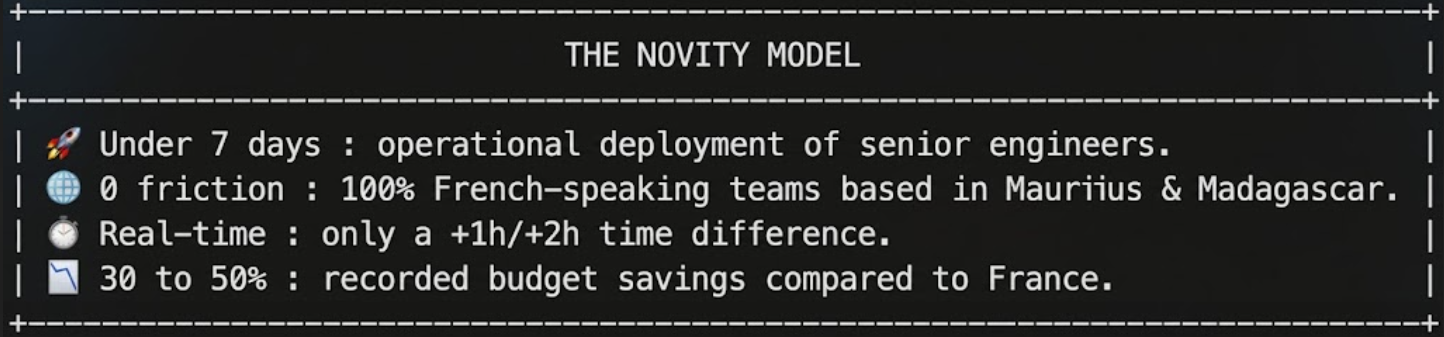
One that gives access to senior engineers who can start in under a week, while supporting their long-term commitment to the project.
Collaborative engineering: The integrated team model
Since 2019, Novity has developed an integrated engineering team model designed as an alternative to standard nearshore and offshore outsourcing.
Through our two engineering hubs in Mauritius and Madagascar, we build stable, long-term technology partnerships.
Our teams are 100% French-speaking and work in closely aligned time zones, with only a one- or two-hour difference.
Rather than working as a separate outside team, our engineers join clients' development environments, workflows and existing processes.
This approach cuts cultural and language barriers while keeping work steady across the tech stack.
It also supports the long-term growth of existing systems and stronger technical collaboration, especially during acquisitions or when coordinating development across multiple units.
✅ Checklist: Assessing the Resilience of Your Tech Delivery Model
- Financial runway and fixed costs: Can you increase or reduce your engineering team by 25% within 30 days without significantly affecting fixed operating costs?
- Administrative workload: Does your management team spend less than one working day per week sourcing engineering talent?
- Collaboration and alignment: Do your external technology partners collaborate synchronously and in real time with your internal teams?
- Project continuity: Are your technical documentation and product knowledge protected against the departure of a key team member?
These questions help identify potential weaknesses in engineering capacity, operational efficiency and long-term product stability.
Technology Market Trends: Investors Are Becoming More Selective
Market data reflects the growing emphasis on measurable performance and operational discipline.
According to KPMG's Tech Insights report, published in January 2026, fundraising activity is returning to growth, but investors remain highly selective, favouring companies that demonstrate strong operational discipline.
Meanwhile, the EY Venture Capital Barometer 2025, referenced by Le Monde Informatique, highlights an adjustment in French IT investment activity.
Analysis published by Les Echos also points to a decline in non-strategic mergers and acquisitions.
Together, these developments reinforce the importance of assessing technical resilience both before and after a transaction closes.
For startups and software companies, the ability to maintain delivery performance, adapt engineering capacity and protect product knowledge is becoming increasingly important.
The real challenge after closing is not simply to grow faster. It is to build an engineering organisation capable of sustaining that growth without compromising financial flexibility or technical quality.
Sources
- Maddyness, Xavier Lernould - Post-funding, post-acquisition: the real test for scale-ups starts here
- EY Venture Capital Barometer 2025 - AI: A catalyst for growth
- Les Echos - French Tech: the sharp decline in mergers and acquisitions
- KPMG - Tech Insights 2025: French tech ecosystem trends for 2026
- Tech 45’ Podcast - Post-funding and acquisition insights from the CEO of AssoConnect


