

In 2026, implementing an ERP or CRM system involves more than automating tasks and bringing data together. Businesses want to use AI to make predictions and process natural language as part of their daily operations.
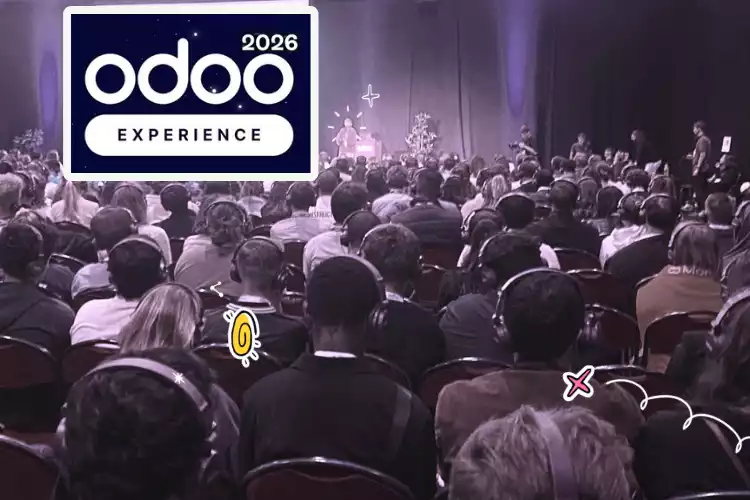
Belgian software company Odoo, now valued at €10 billion, is responding to this shift. The latest Odoo Experience (OXP) 2026 event confirmed the company's direction. It also highlighted the need for implementation partners to rethink their software engineering practices.
Strengthening the Novity–Odoo partnership
Working closely with software providers helps us support clients with complex implementations. This is why Antoine Pougeas, Chief Sales Officer at Novity, attended the annual Odoo Experience event in Brussels.
Our participation had three main objectives:
- Review the product roadmap to anticipate future developments and better advise our clients.
- Assess the technical capabilities of Odoo 20, particularly its built-in AI features.
- Connect with the partner ecosystem and strengthen our relationship with Odoo's teams.
Antoine Pougeas, Chief Sales Officer at Novity
"OXP 2026 highlighted how much the platform has evolved. With version 20, AI is now becoming part of everyday business processes. The event also helped strengthen our position as an official partner. Our goal is to combine Odoo's capabilities with our expertise in custom software development."
Software engineering and architecture: beyond standard configuration
Implementing an ERP or CRM system requires a reliable software architecture. Odoo provides a wide range of standard modules. However, businesses with specific processes often need custom development. This is where software engineering expertise becomes essential.
To adapt Odoo to our clients' needs, our teams use the platform's core technologies. These include Python for backend development and JavaScript, particularly the OWL framework, for frontend development.
Working across Odoo versions 12 to 20 also requires expertise in database management with PostgreSQL, deployment environments such as Docker and Odoo.sh, and version control with Git.
The role of an AI-driven developer
Odoo 20's AI integration is increasing the need for engineers with a broader range of skills.
At Novity, our engineers connect ERP and CRM business processes with external large language models (LLMs).
Matthieu, Senior Software Engineer and Odoo expert at Novity, explains how his role is evolving:
« AI integration is changing how we develop modules. My role is increasingly moving towards that of an AI-driven developer.
I use modern architectures such as Next.js 14 with strict TypeScript. I also design AI agents to improve our development processes, including code reviews and regression detection.
Recently, I developed an integration with the Claude API using the wizard pattern. This automatically generates financial reports in PDF and PowerPoint (PPTX) formats.
This approach requires expertise in LLM orchestration patterns, including RAG, function calling and MCP. These technologies allow AI to interact smoothly and securely with existing software architecture.»
AI certification and structured delivery
Integrating AI into business software requires a structured approach. At Novity, we support our engineers in gaining recognised AI certifications.
More than half of our engineers are currently following Anthropic's Claude Certified Architect – Foundations (CCA-F) certification programme. So far, 15 team members have achieved the certification.
This investment strengthens our ability to integrate generative AI into clients' existing systems. It also supports consistent practices for security, context management and AI orchestration.
Integrated engineering teams for secure deployment
Successful ERP implementation depends on both technology choices and effective collaboration. Novity offers an approach that goes beyond traditional IT outsourcing services.
Our engineers work directly alongside our clients' technology, data and product teams. Based in Madagascar and Mauritius, they follow the same working methods, use the same tools and take part in daily meetings and sprint planning.
Each dedicated engineer contributes to the wider project. They document their code, conduct thorough code reviews and develop an understanding of the client's business processes. This applies across different areas, including inventory management, invoicing and project management. The result is a collaborative approach that connects technical expertise with real business needs.

About Anthropic's Claude Partner Network
The Claude Partner Network is how Anthropic works with the firms that put Claude into production for customers.
The Services Track recognizes partners for building a certified delivery team, delivering Claude use cases for clients, and proving the work through public customer references.
Partners advance through Certified, Select, Preferred, and Global Premier tiers.